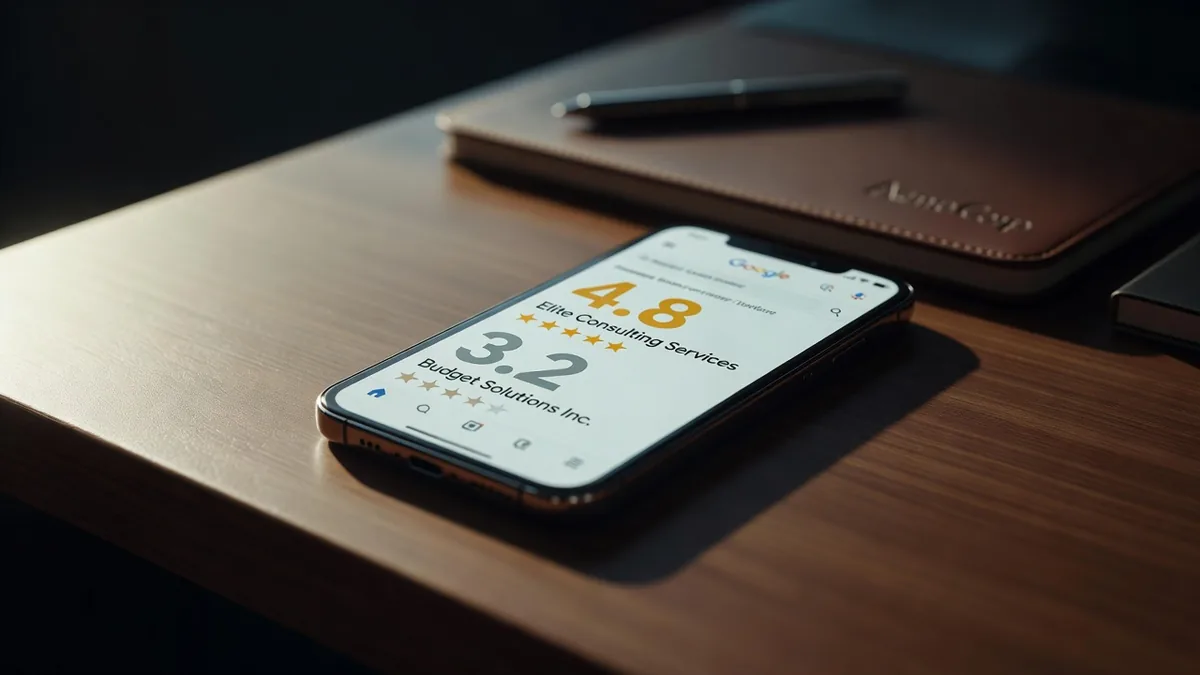
Google just rolled out a feature that looks like a minor tweak. On mobile search results, sponsored ads now display a website’s overall star rating, the same 5-star badge you see on local business listings. Samsung’s ads for phones show it. Amazon’s probably showing it. And by the time you read this, yours might be too.
Most businesses see this and think: “Great. More social proof in the ad. Conversion lift incoming.”
But here’s what nobody’s actually saying out loud: this feature fundamentally changes what “authority” means in Google’s ecosystem, and if your business doesn’t have visible ratings, you’re about to lose clicks you didn’t know you were winning.
The Feature Looks Simple. The Implication Is Not.
Star ratings have been a ranking factor in organic search for years. Google’s own research shows pages with reviews rank better and get higher click-through rates. That’s not controversial, it’s proven.
What’s new is that Google is now bringing that same signal into sponsored results. On a search results page, a user now sees organic listings with stars, and sponsored ads with stars. The playing field looks level. But it’s not.
Here’s the insider angle: if your business has no reviews or low ratings, you’re now competing in Google Ads against both higher-rated competitors AND the organic results above you, all of which likely have better review signals than your ad does.
The feature doesn’t just show ratings. It levels down businesses that don’t have them.
Why This Matters More Than the Feature Itself
For small businesses in North London managing PPC budgets, this creates a new problem: paid visibility now requires the same review foundation that organic visibility requires.
You can’t buy your way past a weak reputation anymore.
Before this change, a small business with poor reviews could still win clicks on Google Ads by bidding high and writing good ad copy. The star rating wasn’t visible, so the ads didn’t surface the trust gap.
Now it does.
We’ve seen this pattern before. Google introduced seller ratings in Shopping ads. Click-through rates on low-rated products dropped. Businesses suddenly realised their review problem wasn’t a “nice to have”, it was a revenue blocker.
The same thing is happening in search ads, but slower, because it’s rolling out gradually on mobile first. By the time this is live on desktop, thousands of businesses will have already lost clicks without understanding why their conversion rates dropped.
The Real Cost: It’s Not Just CTR
The obvious impact is click-through rate. Ads with 4.5 stars will outperform ads with 3 stars or no stars visible. That’s expected.
But there’s a second-order cost that matters more: your Google Ads quality score.
Google factors in user signals when calculating quality score. If searchers skip your ad because the star rating is weak, that skip is data. Google sees it. Your quality score drops. Your CPC rises. Your profitability shrinks.
A business with a 3.2 star rating might need to bid 20-30% higher to win the same position as a competitor with a 4.7 rating, assuming all other factors are equal.
Over a year, that’s real money.
What Most Agencies Won’t Tell You
Here’s the honest bit: many PPC agencies won’t flag this for their clients until it impacts revenue visibly. It’s easier to optimise bids, test ad copy, and report on traffic than to have a difficult conversation about review generation.
But the feature is already live in testing. It’s not coming, it’s here.
For North London businesses running ads right now, the time to build review velocity isn’t next quarter. It’s this week.
Why? Because review systems don’t generate stars overnight. A business starting from zero or 2 stars needs weeks to build visible momentum. Meanwhile, competitors with established ratings are already capturing more clicks in the new interface.
The longer you wait, the wider the gap becomes.
What You Actually Need to Do
This isn’t complicated, but it requires consistency:
1. Audit your current ratings across all platforms. Google Business Profile, Trustpilot, industry-specific sites, even social media. What’s your average? If it’s below 4.2, you have a visibility problem that’s about to get worse.
2. Identify where your best customers already leave reviews. Don’t spray review requests across every platform. Focus on the 2-3 places where your customers are already posting naturally.
3. Implement a review generation system now. Post-purchase emails, SMS follow-ups, QR codes on invoices. This needs to run on autopilot. A business that asks for reviews manually isn’t generating velocity fast enough.
4. Respond to every review, positive and negative. Google’s algorithm weighs recency heavily. A business responding to reviews in real time ranks higher than a business with older, dormant reviews.
5. Audit your ad copy against your ratings. If your ad promises premium service but your Google rating is 3.1 stars, users will click and immediately distrust what they find. Fix the rating, or lower the ad promise.
For web design services in North London, this is especially critical. Services that look premium in the ad but have weak reviews get abandoned at the landing page. A conversion rate optimisation audit won’t fix that, a review strategy will.
The Broader Pattern
This is part of a bigger shift nobody’s talking about: Google is making reputation a ranking signal everywhere.
In organic search, topical authority and E-E-A-T (Experience, Expertise, Authoritativeness, Trust) now drive rankings. In shopping, seller ratings determine visibility. In local, review count and recency are paramount. And now, in paid ads, star ratings are visible at the moment of click.
Every channel is collapsing into the same signal: trust.
Businesses that recognise this early and build review momentum now will own visibility across multiple channels. Businesses that wait until the impact is obvious will be playing catch-up for months.
What Your Competitors Probably Aren’t Doing
Most local businesses are optimising for keywords, bid strategy, and ad copy. The review piece feels “soft”, something to handle later.
That’s exactly why addressing it now is an edge.
While competitors are tweaking headlines, you could be systematically building a reputation that shows up in ads, organic search, and landing pages. That compounds.
If you’re running ads in North London and your ratings are weak, your PPC account is already leaking money, you just can’t see it yet.
Next Steps
Start with your Google Business Profile. That’s the rating Google shows in ads. What’s your current score? How many reviews in the last 30 days?
If those numbers are below average for your industry, this feature is a warning, not an afterthought.
Need help building a review system or optimising your Google presence for ads and organic? We help North London businesses align their reputation, web design, and ad strategy so every channel reinforces the same message.
Call us on 020 3355 8773 or grab a free SEO and ads audit. We’ll show you exactly where the gap is and what’s costing you.


